Beyond the buzz: How energy drinks and caffeine dependence are rewriting youth behaviour
We unpack the growing public-health threat of youth energy drink dependence in the absence of legislative safeguards

By Rob Verkerk PhD, founder, scientific & executive director
Rollback to a rock concert in July 2011, the Superjam in the Albert Hall, London. It was a never-to-be-forgotten fundraiser featuring bands like Deep Purple and was hosted by Jacky Paice, wife of Deep Purple drummer Ian Paice, and head of the charity The Sunflower Jam.
I’ll never forget the interplay between two of the greatest keyboardists the rock world has seen, Jon Lord and Rick Wakeman. It was a privilege to be asked just before the auction to say a few words to the assembled thousands about the need for a revolution in medicine that would see much greater adoption of healthcare methods that were more compatible with humans, their natural environment and our evolutionary background.
What none of us knew on that wonderful evening was that Jon Lord was suffering pancreatic cancer. A month later he was diagnosed with late-stage pancreatic cancer. While Jon was given just months to live, he managed a full 12 months. During that year, Jon had a remarkable journey, not solely in terms of the variety of approaches he used in an effort to manage the cancer. It was 4 months after the diagnosis I remember Jon describing to me this time as the most creative and enlightening period of his life.

Following his passing, his wife Vicky, twin sister of Jacky Paice, set up the Jon Lord Fellowship in Jon’s name.
Today, we announce the first fruits of the fellowship, the publication of a very comprehensive review of the most common form of pancreatic cancer, pancreatic ductal adenocarcinoma or PDAC. The review article has been published in the peer-review journal Integrative Molecular Medicine and views the fifth most common cancer, and the cancer with the lowest survival rate, through a genetic and epigenetic lens.
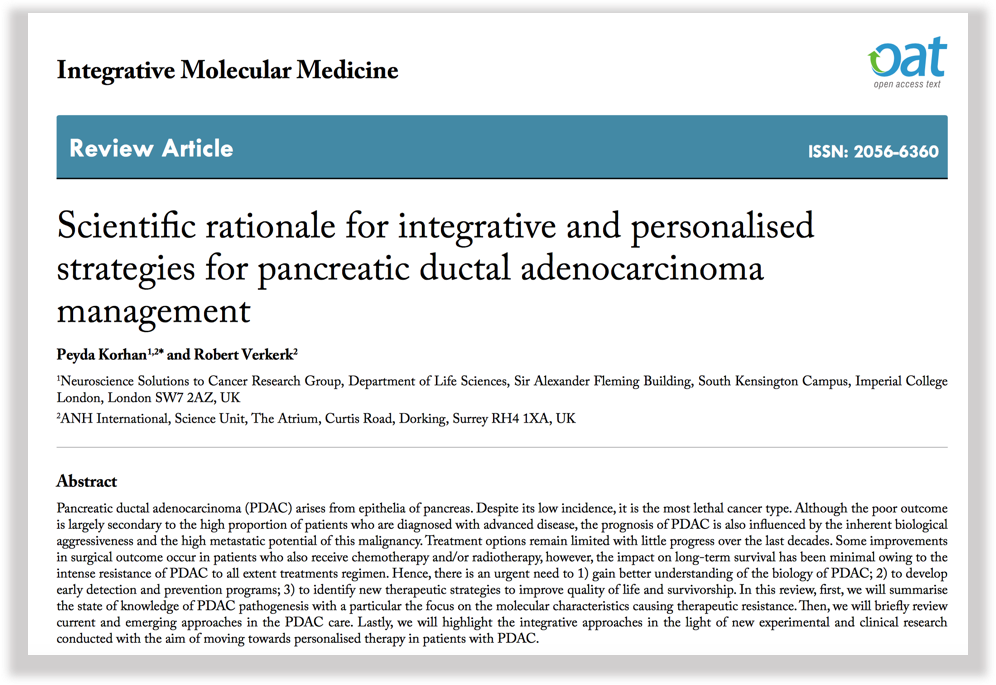
Despite shifts in the way surgical techniques, chemotherapy and radiotherapy have been deployed over recent decades, survival rates have been almost static for the last 40 years, with no more than 1 patient in every 100 surviving more than 10 years.
The review also evaluates emerging treatment approaches. Most importantly, it proposes that knowledge of an individual’s genetics can be used to inform a personalised approach to pancreatic cancer treatment including natural modalities that could substantially improve outcomes, especially among those where cancer is detected at an earlier stage.
It has been a great privilege to help steer this project over the last two years.
We sincerely hope that the work, carried out in Jon Lord’s name, contributes, one way or another, to a positive shift in the clinical management of pancreatic cancer, as well as to its improved prevention.
We unpack the growing public-health threat of youth energy drink dependence in the absence of legislative safeguards

Our weekly roundup of the latest natural news from across the globe in one place. This week: Are digital spaces harmful to young people?; Food preservatives & T2D; Gut health & brain health; Changes to US & UK childhood vax schedules; Being creative keeps our brains young; Updates from ANH-USA; Threats to Free Speech; Post-covid related and much more…

Event Upcoming Member events Members’ Briefing and Q&A – January 2026 Date: Wednesday 21st January 2026 Time: 18:00 (6:00 pm) – 19:30 (7:30 pm) GMT

Check out our snapshot of a wild year defending our right to natural health in an ever more complex world.